Identify the faucet type first
Four main types exist, and the repair differs. A compression faucet has two handles and rubber washers. A cartridge faucet has one or two handles and a cartridge inside. A ball faucet has a single handle on a ball-shaped joint. A ceramic disc faucet has a single handle and ceramic discs.
Look at the handle. If it turns many times and then stops, it is a compression faucet. If it moves smoothly in a short arc, it is a cartridge, a ball or a disc.
What usually wears out
Compression
The rubber washer or the seat. Replace both.
Cartridge
The cartridge itself or its O-rings.
Ball
The seats and springs, or the whole ball.
Ceramic disc
The cylinder or its seals.
A basic repair, step by step
Always shut off the water first.
Close the shutoff valves
Turn the valves under the sink clockwise. Open the faucet to drain the line.
Plug the drain
A small part dropped down the drain is gone.
Take off the handle
Pry off the cap, remove the screw and lift the handle.
Pull the cartridge or washer
Unscrew the retaining nut and lift out the part. Note how it sits.
Replace and test
Fit the matching new part, reassemble and turn the water back on slowly.
When to replace the faucet
If the faucet is corroded, the body is cracked or parts are no longer made, replacing it is better than repairing it. A new faucet also gives you a chance to choose a lower-flow model.
Our faucet repair page explains how we decide. Water in a cabinet is a bigger problem, and the leak detection page explains how to trace it.
What a drip costs
One drip per second adds up to many gallons per month, depending on the size of the drip. A hot water drip also costs you the energy to heat it.
A quick repair is cheaper than the water. If you are not sure which part to buy, take the old one to the store.
Parts and tools
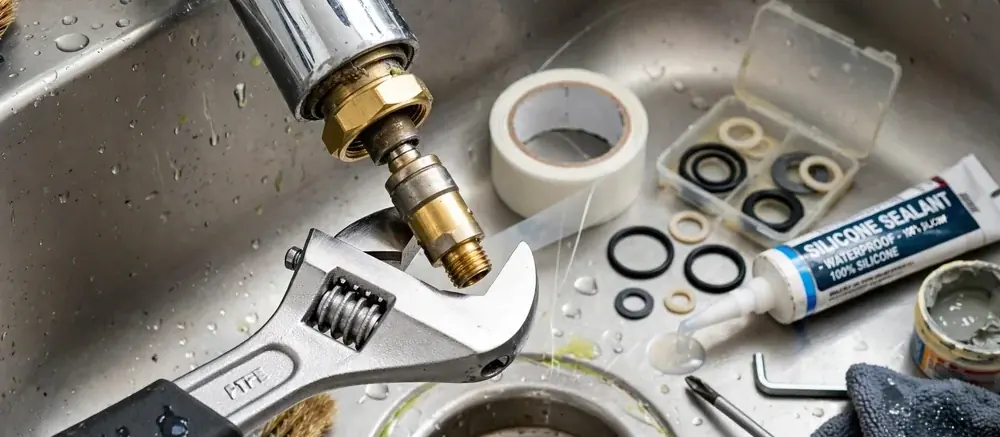
You need an adjustable wrench, a screwdriver set, a hex key set, plumber's grease and the replacement part. A small bowl keeps screws from rolling away.
Take photos as you disassemble the faucet. The order the parts came off is the order they go back on.
Kitchen, bath and outdoor faucets
A kitchen faucet with a pull-down sprayer has a hose and a weight. A leaky sprayer is a different repair from a leaky spout. A bathroom faucet is usually simpler and has a pop-up drain that can also leak.
An outdoor faucet needs different care in winter. See faucet repair for how to deal with a hose bib.
Do not overtighten
More force does not stop a drip. It cracks the seat or strips the threads. If a faucet still drips after a new part, the seat may be worn and need resurfacing or the faucet may need replacing.
A plumber can tell you which in a few minutes.
Common faucet leaks and the fix
| Where it leaks | Likely part | Fix |
|---|---|---|
| Spout tip | Cartridge, washer or seat | Replace the part |
| Base of the spout | O-rings | Replace and grease |
| Handle | Cartridge or packing nut | Tighten or replace |
| Under the sink | Supply line or shutoff valve | Replace the line or valve |
A note on water pressure
High water pressure strains every washer and cartridge in the house. Several faucets that start dripping within a short time can point to a pressure problem.
A plumber can test the pressure at an outdoor spigot with a gauge and install or adjust a pressure-reducing valve if needed.
Know when a drip is a warning
A drip that appears on several faucets at once often means the house pressure is too high or the water heater is overheating. One faucet is a part problem, while several is a system problem.
Mention it to your plumber so the pressure and the heater setting get checked on the same visit.
According to the City of Louisville 2026 Annual Water Quality Report: see the local note above.
Louisville water and faucet parts
The City of Louisville's 2026 Annual Water Quality Report names chlorine as the disinfectant and does not report water hardness. Mineral deposits are a common reason cartridges stick, so ask the City for its hardness data or test your tap.
An aerator clogged with mineral flakes can cause low flow and spraying. Unscrew it and soak it in vinegar before assuming the faucet is bad.
Questions we hear most
A worn washer, cartridge, O-ring or seat. The type of faucet decides which part.
Often yes. Shut off the water, note how the parts fit and take the old part to the store.
Count the handles and see how they move. A faucet that turns many times is a compression type.
A clogged aerator. Unscrew it and clean it.
The City's report does not list a hardness figure. Test your tap, and clean aerators now and then.
If the shutoff valves will not close, the faucet body is cracked or the leak is inside the wall or cabinet.
Stuck on leaky faucet repair? A plumber can look at it in person, any hour.