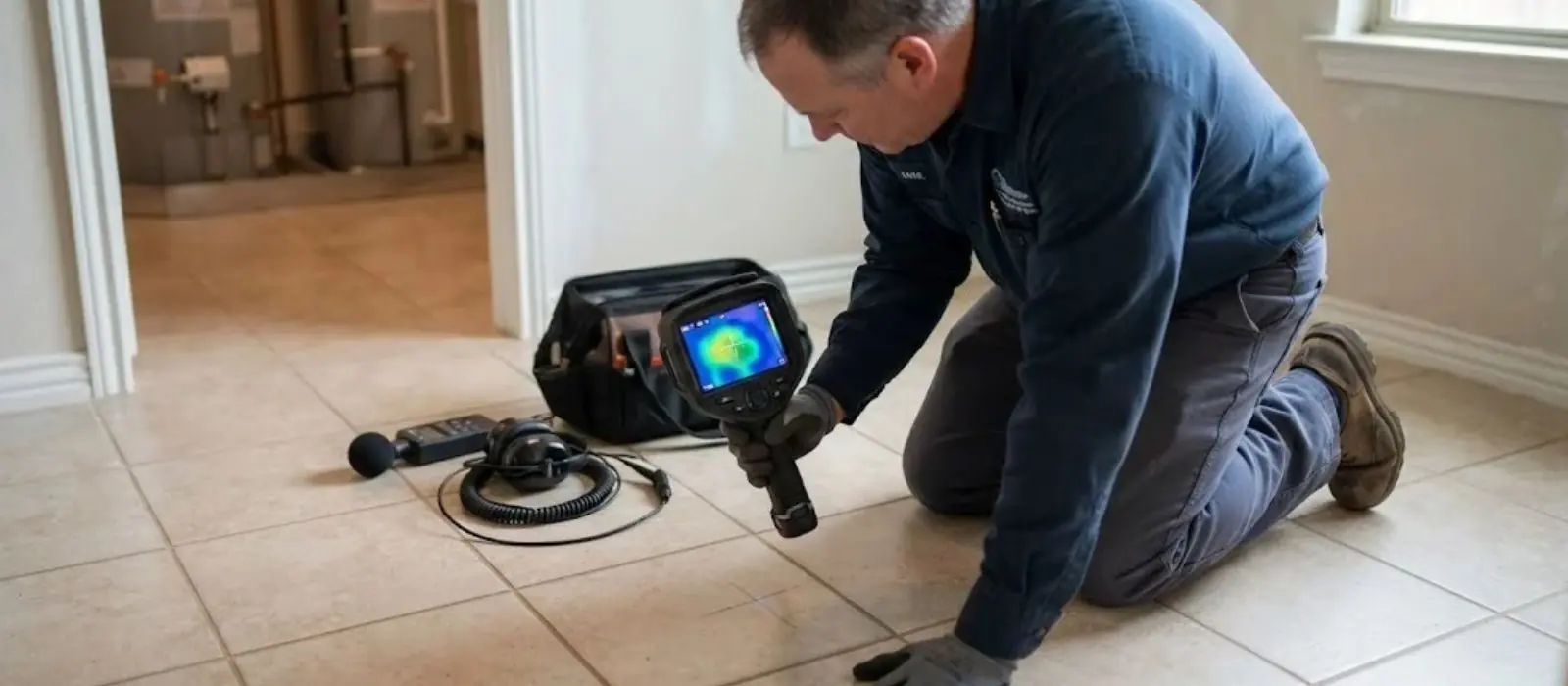
Finding a leak before you open a wall
Leak detection locates a water leak without tearing out finished surfaces. The plumber narrows the source with pressure tests, listening gear and thermal imaging, then opens only the spot that matters.
In Louisville, CO, the usual triggers are a high water bill, a warm patch on a slab floor, a musty smell in a finished basement or a meter that keeps turning. The 24/7 line is open.
Once the leak is found, a burst section goes to burst pipe repair and a failed buried line goes to water service line repair. We trace leaks in Lafayette homes as well.
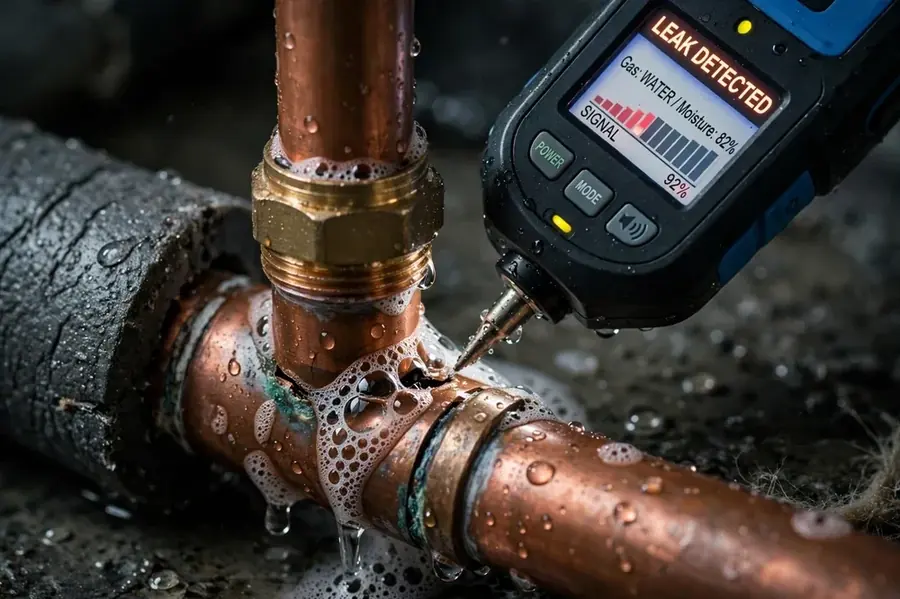
Suspected leak: try this meter test first
You can learn a lot in ten minutes with no tools. It tells us whether water is leaking on the house side of the meter.
- Close every tap and make sure the dishwasher, washer and ice maker are not running.
- Find the water meter and look at the small leak indicator or the sweep hand. Write down the reading.
- Wait fifteen minutes without using water, then read it again.
- If the dial moved, water is escaping somewhere. Shut the main valve and check whether the dial stops.
- If the dial still moves with the main closed, the leak is before your valve. Call us, and call the City too, because that portion may be city owned.
Signs of a hidden leak
A bill that jumped
A leak that runs all day uses far more than a dripping tap and shows up on the next bill.
Warm floor spots
A hot water line leaking under a slab can warm the floor above it.
The sound of running water
A faint hiss or trickle at night, when the house is quiet, points to a pressurized line.
Damp drywall or a musty smell
Moisture behind a wall shows up as staining, bubbling paint or a smell that returns.
Where the leak is matters for who owns the repair
The City of Louisville's detail sheets split the water service line into a property-owner portion and a city-owned portion, with a curb stop between them. A leak on the house side of the curb stop is the owner's to repair. A leak on the street side is the City's.
That is why the meter test above matters. If you suspect the leak is on the service line, our water service line repair page explains how that repair works. For everything inside the walls and under the slab, the detection comes first.
Slab leaks and Louisville soils
The Colorado Geological Survey calls expansive soil Colorado's most significant geologic hazard, and notes that swelling ground can disrupt pipelines and sewer lines. Signs of that movement include cracked basement floors and heaved slabs.
We do not claim every slab leak in Louisville comes from soil movement. We do tell owners that a leak under a slab can start from corrosion, a bad joint or shifting ground, and that finding the exact spot is what keeps the repair small.
How we narrow it down
| Method | What it tells us | Used when |
|---|---|---|
| Pressure test | Whether the supply lines hold pressure | A leak is suspected but unlocated |
| Acoustic listening | The point where leaking water is loudest | Slab or buried lines |
| Thermal imaging | Temperature changes from moisture or hot water | Walls, ceilings and floors |
| Camera inspection | Visual check inside drain lines | Suspected drain leaks |
What affects the price of leak detection
A clear price for leak detection comes before work starts.
Many homeowner policies cover resulting water damage but not the cost of finding the leak, and some cover the access work. Check your policy. Want a real number for leak detection? Call (303) 552-3896.
Leak you cannot find?
Call the 24/7 line. Shut the main valve if water is spreading, and tell us what you see.
Sources: according to the City of Louisville construction detail sheet the water service is split between owner and City, and the Colorado Geological Survey describes expansive soil.
Questions we hear most
Yes. A leak you can hear or a meter that races can be called in at any hour.
Run the meter test. If the dial moves while every fixture is off, water is going somewhere. A running toilet is the most common cause, so check that first.
Usually we can locate it closely with listening gear and pressure tests, then open a small area. Sometimes rerouting the line is a better option than a repair under the slab.
The City of Louisville owns the portion of the service line on its side of the curb stop. Call the City for that portion and us for the house side.
Policies differ. Many cover sudden damage but not slow, long-term leaks, and finding the leak is often not covered. Read your policy and ask your agent.
Then we tell you so and explain what we ruled out. A meter that spins from a running toilet or a faulty irrigation valve is common.
Describe your leak detection problem to a plumber at any hour.