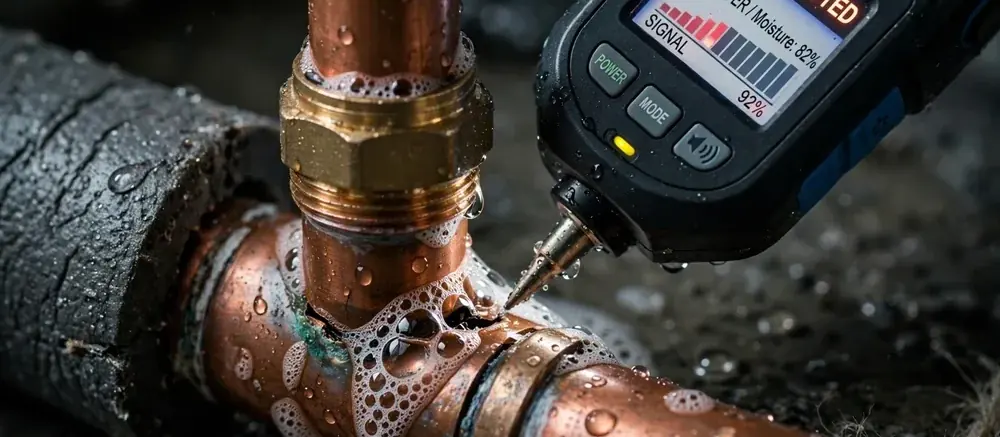
What to do first: stop the water
Every repair starts with shutting off the water.
Close the fixture valve
If the leak is at a sink or toilet, close its shutoff valve.
Close the main
If there is no valve or it does not stop the leak, close the main water valve.
Drain the line
Open a tap at the lowest point to relieve pressure.
Dry the area
Wipe the leak so you can see where it starts.
Photograph
A picture helps with a plumber and with insurance.
Common leaks and the usual fix
Compression fitting weeps
Tighten it a quarter turn. If it still leaks, replace the ferrule.
Threaded joint drips
Disassemble, clean and reseal with tape or sealant.
Supply line leaks
Replace the braided line. They are cheap.
Pinhole in copper
A temporary clamp helps. Permanent repair means cutting out the section.
Leaks you should not patch
A leak inside a wall, under a slab or on the main line deserves a plumber. So does a leak in a pipe that has several weak points. Patching it again and again wastes money.
If you see water stains on a ceiling, soft drywall or a floor that stays damp, the leak may be bigger than it looks. Our leak detection page explains how we locate it.
When leaks keep coming
Several leaks in a short time say the pipe is failing. Corrosion, high pressure and old fittings are the usual causes. In that case a longer repair or a repipe may cost less than repeated patches.
See repiping to understand the option. A pressure check is a cheap way to find out if high pressure is the cause.
Document for insurance
Photograph the leak and the damage, keep receipts and write down when you noticed it. Insurers often cover sudden damage but not slow leaks, and the timing matters.
A plumber's written report on the cause helps. Ask for one.
Temporary fixes that buy time
A rubber clamp, an epoxy putty stick or self-fusing tape can slow a pinhole leak while you wait for a plumber. They are temporary, and they should not be left in place for months.
If you use a temporary fix, mention it when you call. The plumber will want to know where it is and what pipe it covers.
Fixtures versus pipes versus appliances
Many leaks are at fixtures, such as a toilet supply line or a faucet. Others are at appliances, such as a washing machine hose or an ice maker line. Pipes themselves leak less often than their joints.
Check the cheap suspects first. A hose that costs a few dollars is a likely cause.
Mold and moisture afterward
Fix the leak first, then dry the area. Moisture that lingers can grow mold in a day or two. Open walls where you can and use fans.
If drywall is soft or smells musty, a water mitigation company can check for hidden moisture.
Where leaks hide
Leaks show up far from where they start. Look for these clues.
| Clue | What it suggests | Next step |
|---|---|---|
| Stain on a ceiling | A leak in the floor above | Check that bathroom and call |
| Warm spot on a floor | A hot line leaking | Call for detection |
| Musty smell in a closet | A slow leak behind a wall | Check the meter |
| Higher bill with no change in use | A leak somewhere | Run the meter test |
Washing machines, ice makers and dishwashers
Appliance hoses are a top source of household leaks. A rubber washer hose that is a few years old can split. Braided stainless lines last longer, and an auto-shutoff valve is cheap insurance.
Check behind the refrigerator and under the dishwasher once a year. A drip you can see is better than a stain you find later.
We trace and repair leaks in Lafayette and Broomfield homes as well as Louisville, using the meter test described above.
According to City of Louisville Building Safety, the construction detail sheet and the 2026 Annual Water Quality Report: see the local note above.
Permits, water and ownership in Louisville
The City of Louisville's Building Safety division lists standalone plumbing work as needing a permit, and its phone number is (303) 335-4584. A like-for-like repair of a leak is routine, but ask Building Safety about larger work.
The City's construction detail sheet splits the water service into an owner portion and a city portion, and the 2026 water quality report lists 303-335-4741 for service line questions. If the leak is on the buried line, those answers decide who fixes it.
Questions we hear most
Run the meter test with all water off. If the dial moves, water is escaping. A plumber can locate it with listening gear and pressure tests.
Tape helps on threaded joints. It does not fix a cracked pipe or a failing fitting.
A like-for-like repair is routine. Call Building Safety at (303) 335-4584 about bigger projects.
The City handles its portion of the service line. We handle the owner's portion.
Many policies cover sudden damage but not slow leaks. Read your policy.
Several leaks in a short time may justify it. We assess and give you options.
Stuck on repair plumbing leaks? A plumber can look at it in person, any hour.