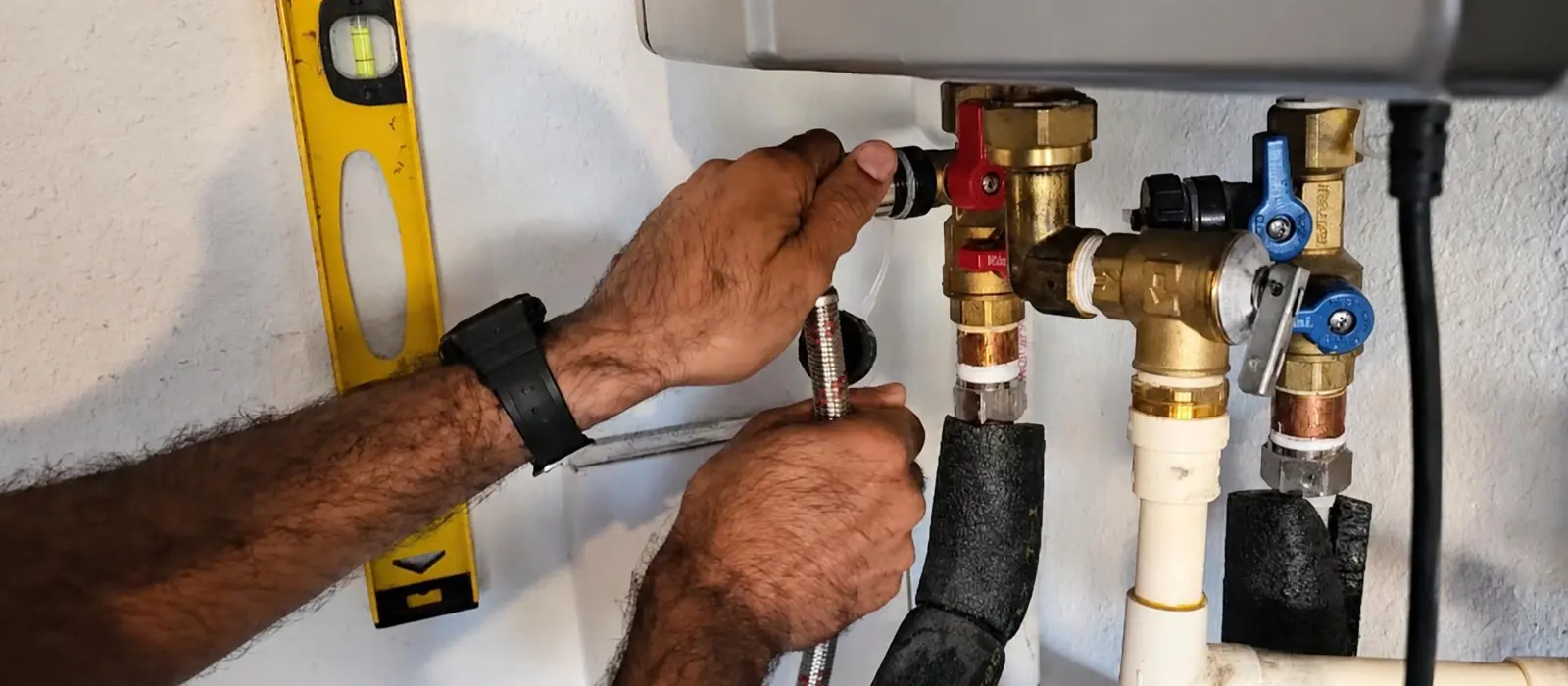
What a tankless water heater is, and who it suits
A tankless water heater heats water only when a tap opens, using a gas burner or electric elements and a heat exchanger. It has no tank to run out of, and it takes far less floor space than a 40 or 50 gallon unit.
It suits households with limited space or high hot water demand, and it works best when the installer matches its capacity to the number of fixtures running at the same time. It does not suit every house, and a good installer will say when a tank is the better choice.
Scale or an error code may only need water heater repair, and a first install follows installation planning. We service tankless units in Broomfield homes too. Compact homes in Steel Ranch are part of our service area.
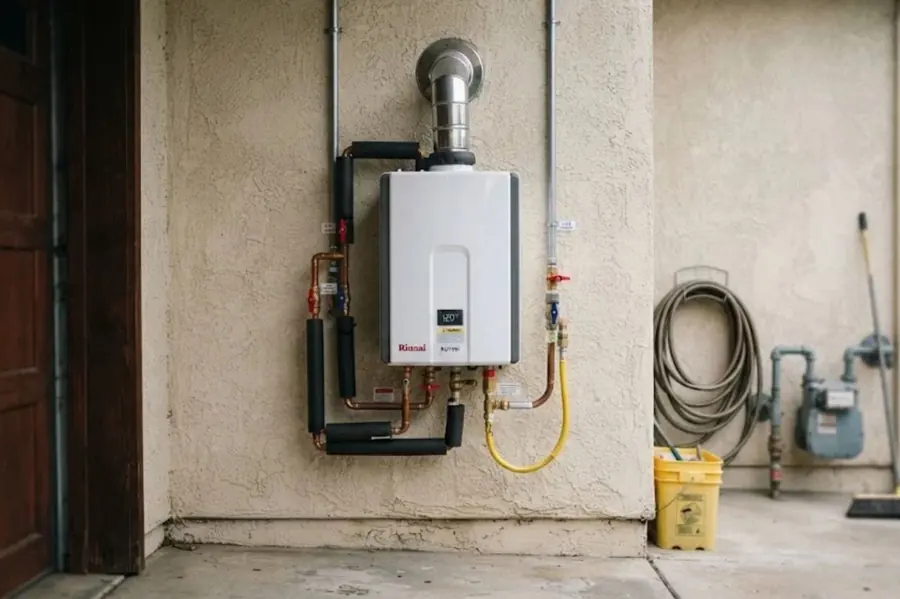
Four things to plan before you buy
Flow rate against temperature rise
A unit's gallons per minute drops as the incoming water gets colder. Winter inlet temperatures on the Front Range are lower than in summer, so size for January, not July.
Gas line capacity
A tankless burner draws more gas at once than a tank. The line to the heater may need upgrading.
Venting
Most gas units need special sealed vent pipe, and elevation of about 5,400 feet means the manufacturer's altitude instructions apply.
Annual service
Scale builds up in the heat exchanger. Regular flushing keeps the unit efficient and the warranty intact.
Is tankless right for your house?
Tankless units pay off most where space is tight or hot water demand is steady. A household that runs two showers and the dishwasher at once needs a larger unit than a couple living alone.
If your gas meter, line size or venting cannot support a tankless burner without costly changes, a high-quality tank may serve better. We would rather tell you that than sell the wrong unit.
Flush and descale: why it matters
Minerals in the water leave scale inside the heat exchanger. As the layer thickens, the unit heats less efficiently and eventually throws an error code or loses flow. A flush circulates a descaling solution through the unit and then rinses it out.
The City of Louisville's water quality report does not list a hardness figure, so test your tap or ask the City for the value. In the meantime, ask us to inspect the inlet filter and the heat exchanger. Many owners are surprised how soon a neglected unit needs help, and a flush is far cheaper than a heat exchanger.
Tankless or tank: how the two compare
| Factor | Tankless | Tank |
|---|---|---|
| Hot water supply | Continuous, limited by flow rate | Limited by tank volume |
| Space | Small, wall mounted | Floor space for a tank |
| Upfront cost | Usually higher | Usually lower |
| Service needs | Annual flush recommended | Occasional flush and anode check |
| Backup during a power loss | Needs power for controls | Gas tanks with a pilot can still heat |
Recirculation and the wait for hot water
A common complaint with tankless units is the delay before hot water reaches a faraway bathroom, and the cold plug of water that can follow a short draw. A recirculating pump and a return line can cut the wait, and some units include one. It adds pump electricity and some wear.
We help you decide whether a recirculation setup fits your house, since a house with a short trunk line may not need it. If your tank water heater is also giving you trouble, our water heater repair page covers diagnosis.
What affects the cost of tankless service
Prices vary more than with tanks, so a written scope helps.
Insurance will not pay for scheduled service, though a manufacturer warranty may require it. Want a real number for tankless water heater? Call (303) 552-3896 with the model number.
Sources: the City of Louisville 2026 Annual Water Quality Report, plus manufacturers' venting and altitude guidelines.
Questions we hear most
Manufacturers often recommend yearly, and more often where the water is hard. Check your manual and ask us to look at the inlet filter during the visit.
No. The controls and igniter need electricity. A small backup battery can run the unit for a limited time.
Usually, but the gas line, the venting and the electrical outlet may need work. We check them before quoting.
Common causes include scale, a dirty filter, venting problems or a failed sensor. We read the code and test the part.
Not usually, but a unit that stops delivering hot water is a good reason to call. See emergency water heater repair if you have no hot water.
Manufacturers rate them for longer service than tanks, but that depends on the water and maintenance. Neglected units fail early.
Describe your tankless water heater problem to a plumber at any hour.