Before you buy: what your sink needs
A disposal needs three things: a sink flange that fits, a nearby outlet or a hardwire connection and a drain that leads to a working trap. Many kitchens already have an outlet under the sink, often switched on the wall.
If there is no outlet, an electrician should add one, and some jurisdictions treat new circuits as permitted work. In Louisville, call Building Safety at (303) 335-4584 to ask whether your project needs a permit.
Choosing a disposal
Continuous feed
The common type. It runs as long as the switch is on and takes food waste a little at a time.
Batch feed
Runs only with a stopper in place. Some people prefer it for safety.
Horsepower
Larger motors grind tougher scraps and last longer, and they cost more.
Dishwasher connection
If you have a dishwasher, the disposal has a port for its drain hose. Remove the knockout plug.
The installation, in order
Turn the power off at the breaker before you start.
Remove the old unit
Support it, loosen the mounting ring and lower it out. Disconnect the drain pipes.
Set the new flange
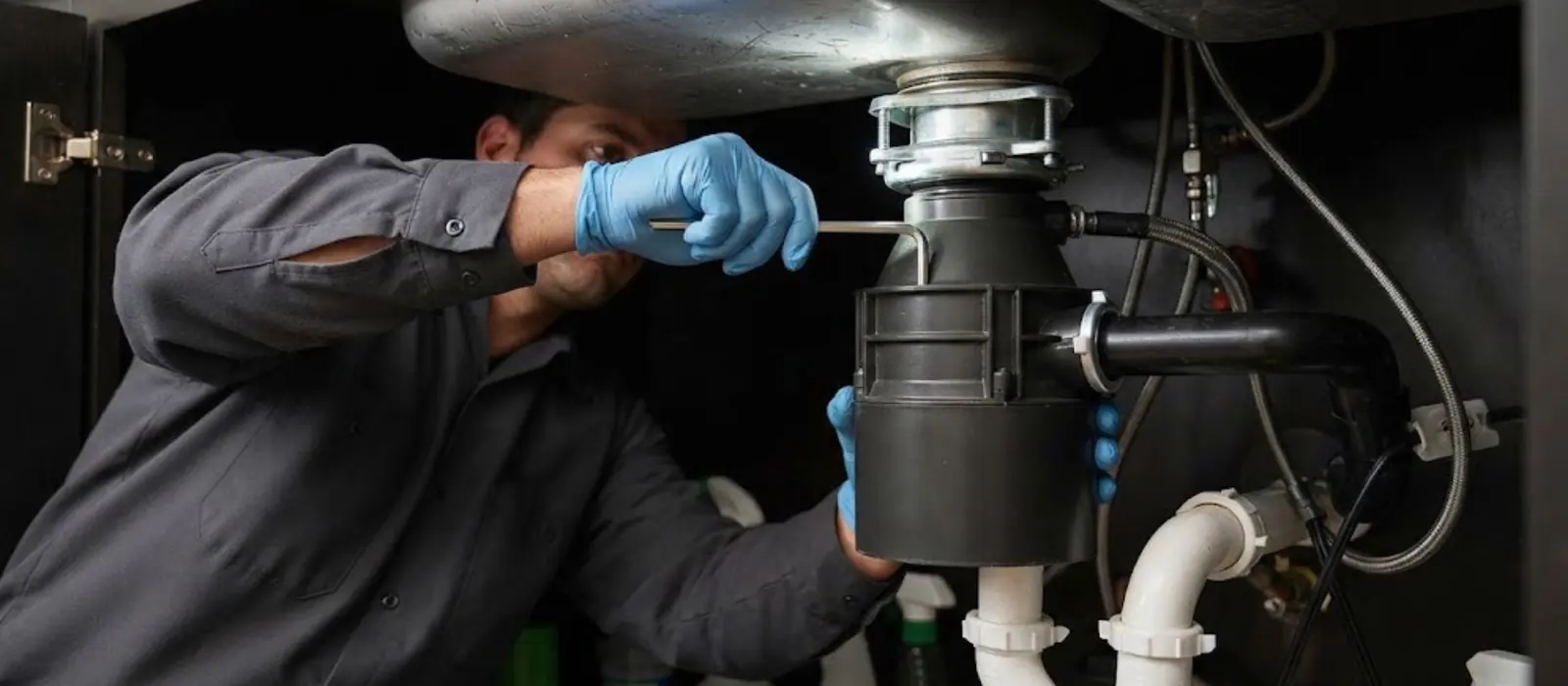
Apply plumber's putty under the sink flange and tighten the mounting hardware from below.
Mount the disposal
Lift it onto the mounting ring and lock it in place.
Connect the drain
Attach the discharge elbow and align it with the trap. Reconnect the dishwasher hose.
Wire and test
Connect the power cord or wires, restore power and run water to check every joint.
Where first-time installs go wrong
A loose mounting ring leaks at the flange. A drain that is misaligned strains the joints and leaks later. Forgetting to knock out the dishwasher plug makes the dishwasher drain slowly or back up into the sink.
A disposal does not fix a slow drain. If the sink backs up with the disposal off, the clog is downstream, and our drain cleaning page explains how plumbers clear it.
When to call a plumber
Call if the sink drain pipe is corroded, the trap is old, there is no electrical outlet or the cabinet is tight. A failed install can flood a cabinet and soak the floor, which costs more than the installation.
We install and repair disposals, and the work is described on our garbage disposal repair page.
What a disposal cannot handle
Bones, fruit pits, shells, stringy vegetables and large amounts of starchy food can jam or clog. Grease is the worst, since it coats the pipe wall after the water cools.
A good habit is to scrape plates into the trash first and use the disposal for small leftovers. The drain behind it will last longer.
Safety checklist before you start
A few minutes of care prevents the common injuries.
Power
Turn off the breaker and test the wires with a tester before touching them.
Hands
Never reach into the unit. Use tongs for anything stuck.
Water
Close the supply valves and drain the trap before disconnecting pipes.
Support
Hold the old unit as you loosen it. It is heavier than it looks.
Where to run the dishwasher drain
The dishwasher hose connects to a small port on the side of the disposal. It should rise in a loop under the counter before it drops to the port, so wastewater cannot siphon back into the dishwasher.
If your home has an air gap on the counter, keep it. A high loop and an air gap both prevent dirty water from returning to the dishes.
Neighbors in Lafayette and Broomfield call us for disposal installs too, and the steps above are the same there.
According to City of Louisville Building Safety guidance and the City's construction detail sheet: see the local note above.
Louisville rules that touch this project
The City of Louisville's Building Safety division lists standalone plumbing work as needing a permit and handles permit questions at (303) 335-4584. The City adopted the 2024 International Plumbing Code with an effective date of December 6, 2025. A like-for-like disposal swap is routine work, but ask Building Safety if you are changing the drain or adding a circuit.
The City's construction detail sheet makes the sewer service line the property owner's responsibility. A disposal sends more solids into the drain, so keep grease out of the sink and the line stays clear.
Questions we hear most
Not safely without adding one. An electrician or plumber can add an outlet or hardwire the unit. Ask Building Safety whether a permit applies.
It uses the existing sink drain, but the trap and pipes must be sound and in line.
Used properly it is fine. Grease, coffee grounds in bulk and fibrous scraps cause trouble. Keep those out.
A swap takes about an hour or two. A first-time install with new wiring takes longer.
Call Building Safety at (303) 335-4584. The City lists standalone plumbing work as needing a permit, and they can tell you how they treat a like-for-like swap.
Under the City's construction detail sheet, the owner is responsible for the sewer service line, including inspection and repair.
Stuck on garbage disposal installation? A plumber can look at it in person, any hour.