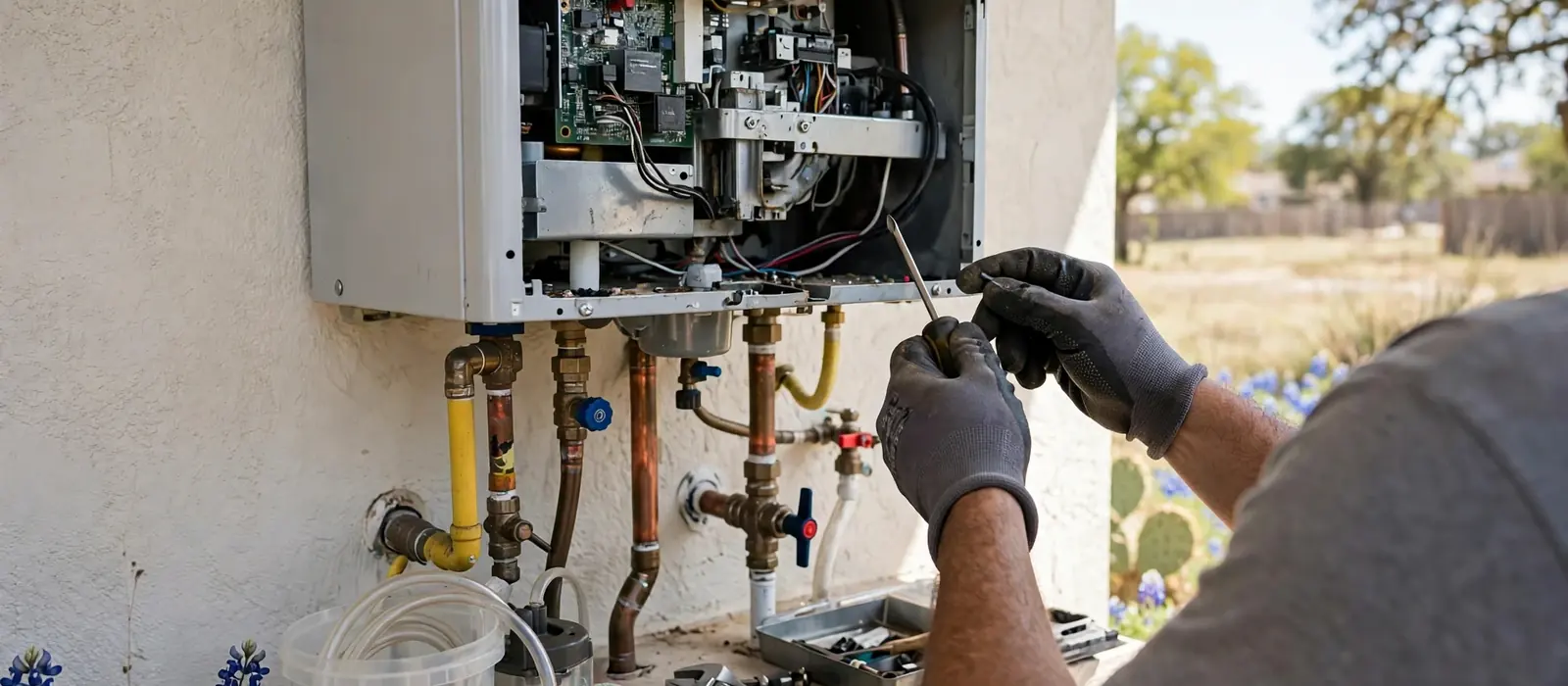
Why tankless venting is different
A tank heater is often vented through a large metal flue that rises on natural draft. Many tankless gas units use a sealed, power-vented system with plastic or stainless pipe, because the exhaust is cooler and has to be pushed out.
That is why a swap is not always a drop-in. The old flue may not suit the new unit, and the new vent may need a path through a wall or roof.
Vent types at a glance
| Type | How it works | Typical use |
|---|---|---|
| Direct vent | Draws air from outside and exhausts outside through two pipes or one coaxial pipe | Closets and living areas |
| Power vent | A fan pushes exhaust out | Longer runs |
| Natural draft | Hot gas rises up a metal flue | Older tank heaters |
| Condensing | Extracts more heat and produces acidic condensate | High-efficiency tankless, needs a drain |
What to plan for
Vent path and length
Each manufacturer limits how long and how many elbows the vent may have.
Clearances
Terminations must stay clear of windows, doors and air intakes, as the manufacturer and the code specify.
Condensate drain
A condensing unit needs a drain line, and sometimes a neutralizer.
Combustion air
A tight house needs a way to bring air to the burner.
Louisville's elevation
Louisville sits at about 5,400 feet. Gas burners produce less heat at altitude, and manufacturers publish instructions for installing at high elevation. Some units adjust automatically and some need a setting changed.
We read the manual for your unit before we install it, and we do not rely on rules of thumb. If a contractor does not mention altitude, ask.
Choosing the location
A garage or an exterior wall often makes venting simple. A basement may need a longer run through a rim joist. An interior closet needs sealed combustion.
See our tankless water heater page for sizing, and water heater installation for permits and placement.
Common venting mistakes
Mixing vent pipe from different manufacturers is one. Each brand approves specific materials and fittings, and using another can void the warranty and create a hazard. Sloping the vent the wrong way is another, since condensate must drain away from the unit.
Terminating the vent too near a window or an air intake pulls exhaust back into the house. Distances come from the manufacturer's instructions and the code, so confirm them before drilling.
Gas line capacity
A tankless burner can draw several times the gas a tank burner does. The pipe from the meter to the heater has to carry that load. Old half-inch lines may need replacing, and the meter itself may need to be checked by the gas utility.
Ask the installer to size the gas line, not just the heater. A fine unit on an undersized line will shut down when two showers run.
Venting options and where they fit
| Option | Good fit | Watch for |
|---|---|---|
| Sidewall direct vent | Exterior wall near the heater | Clearance to windows and meters |
| Roof vent | Interior closets and basements | Roof penetration and flashing |
| Existing flue reuse | Only when approved by the maker | Sizing and condensate |
| Outdoor-rated unit | Mounted outside the house | Freeze protection in cold snaps |
Winter and freeze protection
Colorado winters bring hard freezes. A heater on an exterior wall or in an unheated garage needs freeze protection and a condensate line that will not ice up. The manufacturer's instructions say what is allowed.
If the heater is outdoors, check what the unit is rated for. A heater that is not rated for outdoors can fail the first winter.
What to hand your installer
Give the installer the model number, the planned location and any photos of the existing flue. Tell them about the elevation and the gas meter size if you know it.
A good installer will walk the vent path before quoting. A bid with no site visit is a guess.
We plan tankless vent paths for homes in Lafayette and Superior as well as Louisville, and the manufacturer's instructions govern each one.
According to City of Louisville Building Safety guidance and manufacturer instructions: see the local note above.
Louisville permit and code for venting
The City of Louisville's Building Safety division lists replacing a water heater as needing a permit and answers questions at (303) 335-4584. The City adopted the 2024 International Plumbing Code, effective December 6, 2025, and the inspector confirms venting and gas piping.
We do not quote vent length or clearance numbers here. Those come from the manufacturer's instructions for your model and from the inspector, so confirm them for your project.
Questions we hear most
Sometimes, but not always. Many tankless units need their own vent pipe. The manufacturer's instructions decide.
Yes. At about 5,400 feet the manufacturer's high-altitude instructions apply. Ask your installer about them.
The City of Louisville lists replacing a water heater as needing a permit. Call (303) 335-4584.
That depends on clearances from windows, doors and intakes under the manufacturer's rules and the code.
A high-efficiency model that pulls extra heat from the exhaust and produces condensate. It needs a drain.
Often yes, because tankless units need a sealed, purpose-built vent. Planning it early prevents surprises.
Stuck on venting tankless heaters? A plumber can look at it in person, any hour.