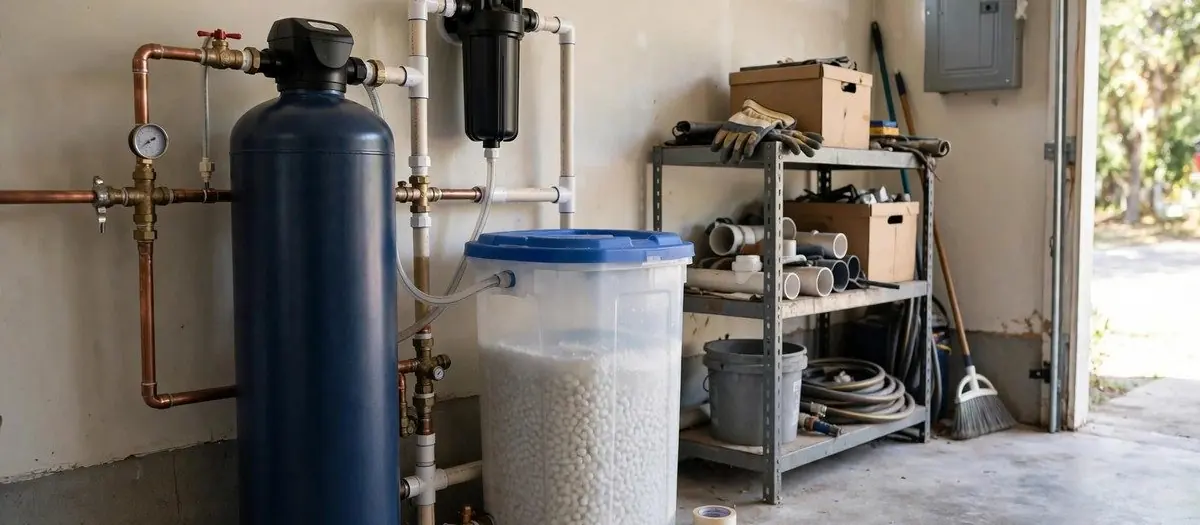
Test first, then treat
Water softeners and filters change what comes out of your tap. A softener removes hardness minerals that cause scale. A filter removes particles, chlorine taste or specific contaminants, depending on the type.
The City of Louisville's 2026 Annual Water Quality Report, covering 2025, names chlorine as the disinfectant and reports copper at a 90th percentile of 0.02 ppm against an action level of 1.3 ppm. It does not list a hardness number. A home test kit or a lab test tells you what your tap carries.
Scale inside a heater is covered on water heater repair and tankless service. We install treatment in Broomfield homes, where the City's hardness range is wide.
Where Louisville's water comes from
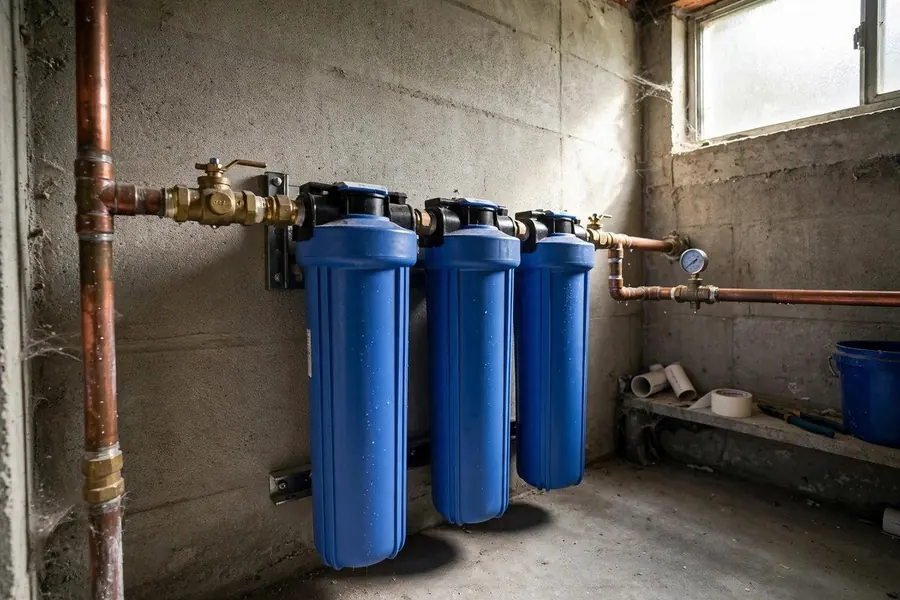
According to the City's report, Louisville's supply is mostly surface water from South Boulder Creek, stored in Marshall Lake, Harper Lake and Louisville Reservoir. The Colorado River supplies a secondary source through Northern Water's Colorado-Big Thompson and Windy Gap projects and the Southern Water Supply Pipeline. Two treatment plants serve the City.
Because the source and the blend can change, the best evidence is the water in your own kitchen. Ask the City for its latest hardness data, or have a sample tested.
Reading a water test
A home test kit can show hardness, chlorine and pH, and a certified lab can test for more. Take the sample from a cold tap that has not run for several hours, as the lab instructs.
Bring the results to us and we match the equipment to the numbers. It is better to size a system to a real result than to guess.
Maintenance you should expect
A salt-based softener needs salt added regularly and an occasional resin clean. Filters need cartridges changed on a schedule, and reverse osmosis membranes wear out over time.
Ask for the yearly cost of salt, filters and service before you buy. A system that is cheap to install but costly to maintain may not be the better deal.
What each system is for
Salt-based softener
Exchanges hardness minerals for sodium or potassium. It protects fixtures and water heaters from scale.
Carbon filter
Reduces chlorine taste and odor. It does not soften.
Sediment filter
Catches sand and particles ahead of other equipment.
Reverse osmosis
A point-of-use system for drinking water, often under the kitchen sink.
Matching the problem to the system
| What you notice | Likely cause | Consider |
|---|---|---|
| White crust on fixtures | Hardness minerals | Softener after testing |
| Chlorine taste or smell | Disinfectant | Carbon filter |
| Cloudy or gritty water | Sediment | Sediment filter |
| Concern about lead in a service line | Service line material | Ask the City, then a certified filter if advised |
Plumbing considerations
A softener needs a drain, power and a bypass valve, and it needs room for salt. Ask your water utility whether any local rules cover softener discharge, and we plan the drain line around the answer before we install.
If scale has already built up inside a water heater, see water heater repair for what a flush can and cannot do. A softener will not remove old scale, but it slows new buildup.
What affects the price of treatment systems
A clear price comes after the test.
This is a planned upgrade and not an insurance matter. Want a real number for water softener and filtration? Call (303) 552-3896.
Sources: according to the City of Louisville 2026 Annual Water Quality Report, which covers supply, treatment, disinfectant and copper results.
Questions we hear most
The City's report does not list a hardness figure, so test your tap or ask the City for the number. Scale on fixtures is the clue.
The City's 2026 water quality report names chlorine as the disinfectant.
It slows scale buildup in the heat exchanger. You should still follow the manufacturer's flush schedule.
Generally yes, though it adds a small amount of sodium or potassium. Some people prefer an unsoftened tap for drinking.
Yes. We check the valve, the brine tank and the bypass, and we replace worn parts.
The City is inventorying service lines. Call 303-335-4741 with questions about yours.
Describe your water softener and filtration problem to a plumber at any hour.